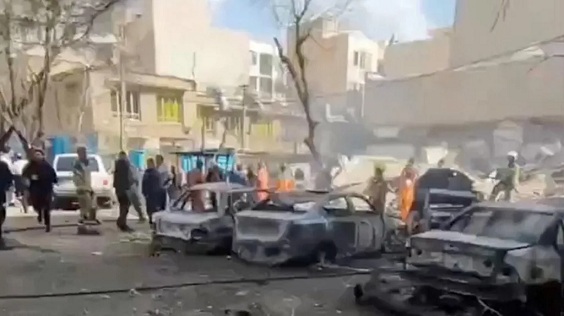

The US and Israel have launched an attack on Iran.
US President Donald Trump has described ongoing “major combat operations” and called for Iranian government forces to lay down their arms.
Earlier, Israel’s defence minister said Israel had launched a “pre-emptive attack” against Iran, with explosions heard across the country.
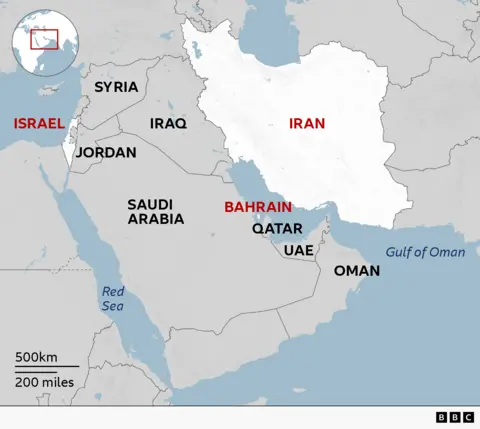
In response, Iran has launched strikes targeting Israel and other sites in the Middle East – including in Bahrain, where the US has a major naval base.
It comes after weeks of threats from the US, and negotiations over Iran’s nuclear programme.
Here’s what we know.
What is happening in Iran?
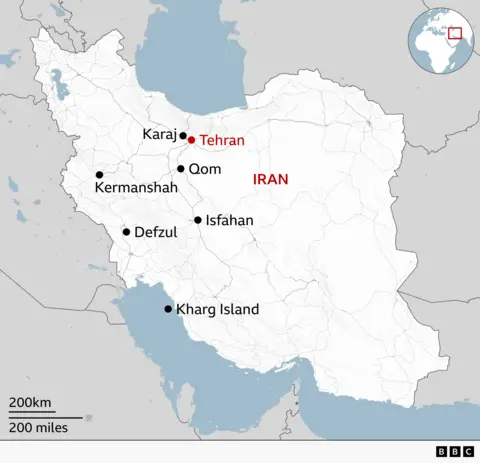
Shortly after 09:30 Tehran time (06:00 GMT), Iranian media reported explosions in the capital. Pictures seen by the BBC show smoke over the city’s Jomhouri Square and Hassan Abad Square.
Explosions were also reportedly heard in multiple other cities across the country, including: Isfahan, Qom, Karaj, and Kermanshah.
Videos circulating on social media show people near blast sites running in panic. The sound of screams and crying can be heard in the background.
The extent of any casualties or injuries are unknown at this point, but a local official told state media that at least 53 people have been killed in an Israeli strike on a girl’s primary school in Iran’s southern county Minab. The BBC has not been able to verify this.
Iran’s airspace has been closed since the attacks, Tasnim News Agency said.
Trump has described the operation as “massive and ongoing”.
Several verified videos show plumes of smoke rising across Tehran.
BBC Verify has located one video within a kilometre (0.6 miles) of Leadership House, the office of Iran’s Supreme Leader, Ayatollah Ali Khamenei. It is not clear from the video angle if it was a direct hit on the building.
The presidential office was also reportedly targeted.
Another verified photo from the same area shows thick, dark columns of smoke rising above residential buildings and small grocery shops. There are also reports of strikes elsewhere in the country.
Iranian Foreign Minister Abbas Araghchi has called the joint strikes “wholly unprovoked, illegal, and illegitimate”.
Earlier, he said Iran will use “all its defensive and military capabilities under legitimate right of self-defence” to protect itself.
In phone calls with counterparts from nearby countries, he also reminded them of what he called their “responsibility to prevent the misuse of their facilities and territories” by the US and Israel, a statement said.
What have the US and Israel said?
Trump posted a video on Truth Social confirming US involvement.
“A short time ago, the United States military began major combat operations in Iran,” he said.
“Our objective is to defend the American people by eliminating imminent threats from the Iranian regime,” he said, adding that Washington’s aim is to “ensure that Iran does not obtain a nuclear weapon”.
He also told the Iranian people to remain in shelter and not leave their homes.
“When we are finished, take over your government,” he said. “It will be yours to take. This will be probably your only chance for generations.”
Israeli Prime Minister Benjamin Netanyahu similarly called on all Iranian people “to throw off the yoke of tyranny and bring about a free and peaceful Iran”.
Thanking Trump, he reiterated his message that Iran “must not be armed with nuclear weapons that would allow it to threaten all of humanity”.
“Our joint action will create the conditions for the courageous Iranian people to take their destiny into their own hands.”
He also advised Israeli citizens to follow guidance from authorities.
Earlier, Israel’s defence minister declared a “special and permanent state of emergency” across Israel.
How has Iran responded?
Israel’s military said it identified missiles launched towards Israel by Iran, saying it was working to “intercept and strike threats where necessary”.
Explosions were heard in the city of Haifa and elsewhere in Israel, but it was not currently clear if these were impacts or interceptions.
Elsewhere in the region, Bahrain’s state news agency reported the service centre of the US Navy 5th Fleet, in Bahrain, was “subjected to a missile attack”.
Qatar’s defence ministry said it “successfully countered a number of attacks targeting the country’s territory”, state media reported, after explosions were heard in the capital Doha.
The country is home to the largest US military facility in the region, Al Udeid Air Base.
Jordanian spokesman Mohammad Momani confirmed they had intercepted two missiles targeting its territory and successfully destroyed them
Kuwait’s air defence also successfully intercepted multiple ballistic missiles, the country’s defence ministry said. A spokesman said the Ali Al-Salem airbase – where the US air force has a presence – was targeted.
Meanwhile, the United Arab Emirates condemned Iran’s attack on its territory, which they say killed one person after falling debris from their air defence intercepts. They added that several missiles were successfully intercepted.
Israelis have been warned against gatherings and going to school and work unless it is essential. The guidance is in effect until 20:00 on Monday (18:00 GMT), authorities have said.
Israel’s airspace is also closed to civilian flights, according to Israeli media.
Is it safe to travel to the region?
Major airlines have diverted or cancelled flights to the Middle East, citing safety, and have apologised to customers.
Wizz Air has suspended flights until 7 March in Israel, Dubai and Abu Dhabi and Amman in Jordan, and in Saudi Arabia until Tuesday.
British Airways has cancelled flights to Tel Aviv and Bahrain until Wednesday, while Saturday’s service to Amman is grounded.
Kuwait’s aviation authority said it was halting all flights to Iran until further notice, according to state media.
Emirates has temporarily suspended its operations to and from Dubai. Lufthansa, Air India, Virgin Atlantic and Turkish Airlines have also announced cancellations.
Some countries in the region – including Iraq and Jordan – have also closed their airspace. The UAE said it has “partially and temporarily” closed its airspace as a precaution, state media reported.
Meanwhile, the UK Foreign Office travel guidance for Jordan, Syria, Lebanon, Iraq, Yemen, Turkey, Saudi Arabia and Oman, is now advising travellers to “remain vigilant, follow local authority advice and take shelter if advised”.
How the world has reacted
United Nations Human Rights Chief Volker Türk has called for “restraint and implore all parties to see reason, to de-escalate, and for a return to the ‘negotiating table'”.
“I deplore the military strikes across Iran this morning by Israel and the United States of America, and the subsequent retaliatory strikes by Iran.
“As always, in any armed conflict, it is civilians who end up paying the ultimate price,” he said, before reminding those involved that protecting civilians is “paramount” under international law.
The European Union’s top diplomat Kaja Kallas called the latest developments “perilous”.
“The EU has adopted strong sanctions against Iran and supported diplomatic solutions, including on the nuclear issue,” she said in a statement on X, adding she has spoken to Israel’s and other regional foreign ministers.
“Protection of civilians and international humanitarian law is a priority.”
Following a government emergency Cobra committee meeting, UK Prime Minister Keir Starmer condemned Iran’s retaliatory strikes on neighbouring countries, and urged them to refrain from “indiscriminate” attacks.
In a joint statement with French President Emmanuel Macron and German Chancellor Friedrich Merz, he said they have consistently urged Iran to end its nuclear programme and to “cease the appalling violence and repression against its own people”.
“We did not participate in these strikes,” the three leaders said. “We urge the Iranian leadership to seek a negotiated solution. Ultimately, the Iranian people must be allowed to determine their future.”
Earlier, a UK government spokesperson said their “immediate priority is the safety of UK nationals in the region,” adding: “We stand ready to protect our interests.”
On Saturday morning, Germany said it had been informed of the attack in advance.
A UN Security Council meeting has been called at 21:00 GMT to discuss the developments.
Saudi Arabia has similarly condemned the retaliatory attacks on Bahrain, the UAE, Qatar, Jordan and Kuwait as it denounced what it called “blatant Iranian aggression”.
“The Kingdom [of Saudi Arabia] affirms its full solidarity with and unwavering support for the brotherly countries, and its readiness to place all its capabilities at their disposal in support of any measures they may undertake,” the foreign ministry said in a statement.
Oman’s Foreign Minister Badr Albusaidi – who had been mediating this week’s US-Iran nuclear talks – said he was “dismayed”.
“Active and serious negotiations have yet again been undermined,” he wrote on X, telling the US that the strikes don’t serve their interests or that of global peace. “I urge the United States not to get sucked in further. This is not your war.”
Following a conference call with ministers and intelligence chiefs, Italian Prime Minister Giorgia Meloni’s office said it would be consulting allies and regional leaders to support efforts to ease tensions.
Australia’s premier Anthony Albanese said his country supported the US “acting to prevent Iran from obtaining a nuclear weapon and to prevent Iran continuing to threaten international peace and security”.
Meanwhile, Russia has condemned the US-Israeli strikes on Iran, calling it a “reckless move”.
“It is also condemnable that the attacks are once again being carried out under the guise of a renewed negotiation process,” the foreign ministry said, referring to the US-Iran nuclear talks which took place on Friday.
The statement also called on the international community to assess what it called “irresponsible actions aimed at undermining peace, stability, and security” in the region.