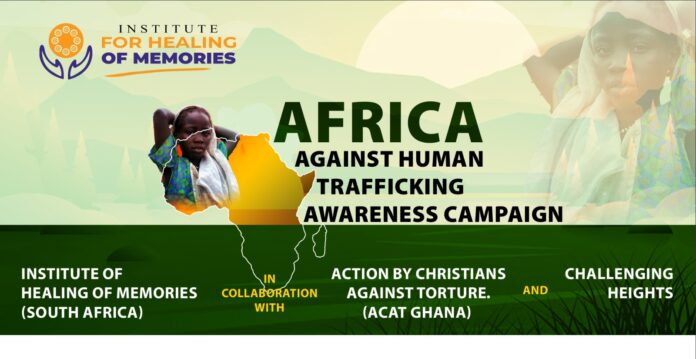

Two human rights organisations have called for stronger national and regional collaboration to tackle human trafficking, describing the crime as one of the gravest threats to human dignity and fundamental human rights in Ghana and across West Africa.
The Institute for Healing of Memories, in partnership with ACAT Ghana (Action by Christians for the Abolition of Torture), has urged government agencies, civil society organisations, faith-based groups, traditional authorities and community leaders to intensify joint action against the growing and evolving menace.
Human trafficking includes forced labour, sexual exploitation, child trafficking, domestic servitude and forced marriage, all of which represent serious violations of human rights.
Global statistics highlight the scale of the problem.
The International Labour Organization estimates that tens of millions of people worldwide are victims of modern slavery.
Data from the International Organization for Migration and the 2022 Global Estimates of Modern Slavery indicate that about 50 million people globally are trapped in modern slavery, including 27.6 million in forced labour and 22 million in forced marriages, with women and girls making up the majority of victims.
Africa accounts for a significant share of these figures, with an estimated seven million people living in conditions of modern slavery, many of them women and children.
Within West Africa, trafficking networks are said to exploit porous borders and economic vulnerabilities to move victims across countries for labour and sexual exploitation.
The groups also referenced findings from the U.S. Department of State Trafficking in Persons Report, which classifies Ghana as a Tier 2 country that serves as a source, transit and destination point for human trafficking.
In Ghana, children are reportedly trafficked internally for forced labour in sectors such as fishing, particularly on the Lake Volta, as well as mining, agriculture, street hawking and domestic work.
The organisations noted that poverty, limited access to education, unemployment, streetism and family vulnerabilities such as broken homes, weak parental supervision and teenage pregnancy often create conditions that traffickers exploit.
Although the Government of Ghana and its partners have taken steps to address the problem, the groups say prosecution rates remain relatively low compared to the scale of the crime, while rehabilitation services for survivors are still under-resourced.
They welcomed comments by Ghana’s Chief Justice, Paul Kwadwo Baffoe-Bonnie, who recently indicated that human trafficking cases are among those being prioritised in specialised courts to speed up adjudication.
The Institute for Healing of Memories and ACAT Ghana stressed that human trafficking goes beyond being a criminal offence, describing it as a profound assault on human dignity, identity and psychological well-being.
They argued that efforts must go beyond rescue operations and prosecutions to include trauma recovery, restoration of personal agency and long-term reintegration support for survivors.
According to the organisations, several gaps continue to fuel the problem in Ghana, including limited public awareness in rural communities, inadequate funding for survivor rehabilitation, weak cross-border intelligence coordination in West Africa, persistent socioeconomic vulnerabilities and insufficient trauma-informed support systems.
To address these challenges, the groups have launched a community-coordinated anti-trafficking and survivor-support initiative. The initiative focuses on public education through outreach to churches, schools, radio and social media, as well as emotional and psychological healing through structured counselling and healing circles.
The programme will also provide survivor support services such as referrals for shelter, legal aid, reintegration assistance and skills training.
It also aims to strengthen policy advocacy to improve enforcement of anti-trafficking laws and increase funding for victim support services.
As part of efforts to raise awareness, the organisations have announced an anti-human trafficking march scheduled for Tuesday, March 17, 2026, in Winneba, followed by a durbar at Akosua Village to highlight the dangers human trafficking poses to individuals and the nation.
The organisers say ending human trafficking will require coordinated action across government institutions, civil society, faith communities, traditional leaders, the media and citizens.