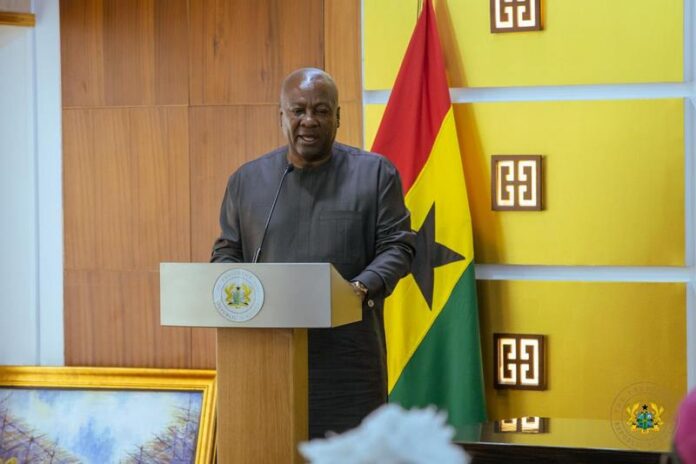

President John Mahama has renewed Africa’s call for reparative justice, insisting the continent has reached a point where “forgetting the past is no longer an option.”
Speaking at the opening of the Diaspora Summit 2025 on December 19, the President said Africa stands at “a very pivotal place” in its historical journey and cannot afford to move backwards or act as if the past never happened.
He cautioned against what he described as deliberate efforts to push Africa into “some sort of amnesia” about “the blood that was spilled, the lives that were lost and the years that were sacrificed” in the struggle for freedom.
President Mahama argued that such calls for forgetting are impossible to accept at a time when people of African descent are described as “garbage and filth,” African nations are labelled “shitholes,” and individuals who look like Africans are stripped of citizenship they have lawfully earned.
According to him, these realities leave Africa with no choice but to confront racism and discrimination head-on.
“This is not a time for excuses or silence,” he said, stressing that the moment demands clarity about Africa’s losses and its future aspirations.
The President revealed that Ghana has already taken steps at the global level, announcing that at the United Nations General Assembly this year, he served notice that Ghana will move a motion next year to recognise the transatlantic slave trade as “the greatest crime against humanity.”
He said he expects the motion to receive full backing from African states and the global African diaspora.
President Mahama noted that Africa has endured slavery, colonialism, genocide and apartheid, insisting that these historical crimes must be formally acknowledged.
He said the continent is demanding the establishment of legal, institutional and international frameworks to advance reparative justice, explaining that reparations must go beyond symbolism.
“They must include tangible measures such as debt cancellation, monetary compensation, return of stolen artefacts, institutional reform and transformative economic redress in the global economic system,” he stated.
Beyond material losses, President Mahama highlighted the lasting emotional and psychological damage inflicted on Africans. He referenced studies on epigenetics, noting that trauma can be passed down across generations, and questioned the long-term impact of centuries of injustice on the health and wellbeing of Africans and their children.
Turning to the future, he urged Africans to be deliberate about unity, saying they must be “more intentional about unity than our oppressors were about division.”
He ended on an optimistic note, reminding the audience that “the future is African,” and expressed confidence that with a united Africa and diaspora, “there is nothing we cannot achieve.”
ALSO READ: