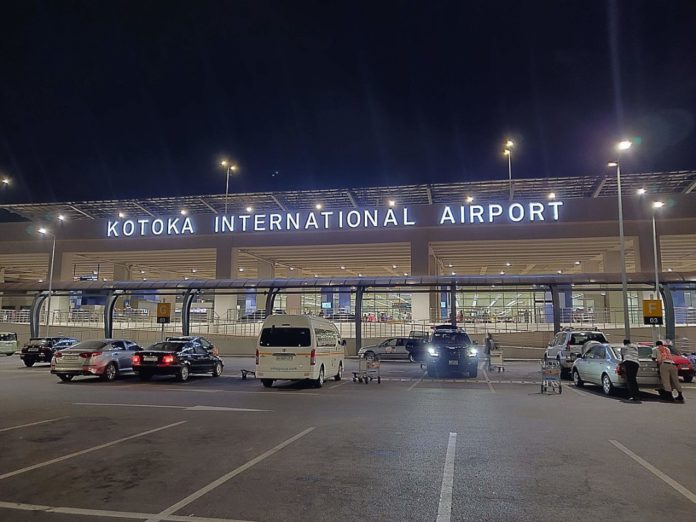

Renowned legal scholar and social commentator, Professor Stephen Kwaku Asare (Kwaku Azar), has weighed into the renewed debate over calls to rename the Kotoka International Airport (KIA), arguing that the move reflects historical simplism rather than genuine national reckoning.
In a strongly worded commentary, Kwaku Azar insists that the push to rename Ghana’s premier airport is “not really about aviation, transport, or national branding,” but rather about how Ghanaians choose to engage their past.
“A nation that is at peace with itself does not spend its time endlessly renaming its landmarks. It spends its time understanding them.”
According to him, history should not be reduced to slogans, selective outrage, or moral shortcuts, warning that such an approach undermines historical honesty and democratic maturity.
Beyond the Coup Narrative
Kwaku Azar challenges the popular argument that Lieutenant General Emmanuel Kwasi Kotoka’s name should be removed solely because of his involvement in the 1966 coup that overthrew Dr. Kwame Nkrumah.
“The argument is often framed this way: Kotoka was part of the 1966 coup; coups are bad; therefore his name must go. That logic is emotionally satisfying but historically unserious.”
He draws parallels with Ghana’s 1992 Constitution, noting that although it was promulgated under a military regime and signed into law by a coup leader, its legitimacy has evolved over time.
“We do not [discard it], because we understand that legitimacy can evolve, and that constitutional value is not erased by the circumstances of origin.”
Why the Airport Was Renamed
Contrary to claims that the airport name celebrates military intervention, Kwaku Azar points to legal and historical records to explain the actual reason for the renaming.
“The renaming of KIA was not intended to glorify the overthrow of Kwame Nkrumah.”
He explains that the decision followed the death of Lt. Gen. Kotoka during the 1967 abortive counter-coup, Operation Guitar Boy, when he was shot at the airport.
“The airport was later renamed to mark the site of his death, not to sanctify military intervention in politics.”
In his view, the name serves as a historical marker of Ghana’s post-independence instability rather than an endorsement of coups.
Applying Consistency to History
Kwaku Azar also questions what he describes as selective moral judgment, citing Ghana’s one-party state era under Dr. Nkrumah.
“We do not honor Nkrumah because he was infallible. We honor him because he was foundational, consequential, and inseparable from the Ghanaian story.”
He argues that if historical figures were subjected to modern moral purity tests, many national symbols would not survive scrutiny.
Colonial Names Still Stand
Drawing attention to Accra’s colonial-era place names, Kwaku Azar notes that Ghana has not erased them despite their origins.
“These names now function as historical markers; entry points for education about who ruled, how power was exercised, and what our forefathers overcame.”
For him, memory and education matter more than cosmetic changes.
Cost and Consequences of Renaming
Beyond symbolism, he raises concerns about the financial, administrative, and international costs of renaming KIA after more than six decades of use.
“What problem, exactly, does this solve?”
He argues that renaming creates the illusion of moral action without addressing deeper national challenges.
Education, Not Erasure
Kwaku Azar concludes by calling for contextualisation rather than erasure, proposing plaques, timelines, and strengthened history education as better tools for national reckoning.
“Let us stop pretending that changing names is the same as confronting history. It is not. It is avoidance dressed up as virtue.”
He warns that forgetting the origins of Kotoka International Airport may do more harm than retaining the name.
“Kotoka International Airport does not dishonor Ghana. Forgetting how and why it got its name just might.”
He ended his post with a light-hearted note in Twi:
“PS: Yɛde post no bɛto hɔ. Yɛnyɛ comprehension consultants. Da Yie!”