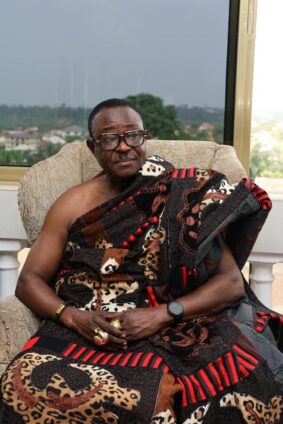

The Odauhene, Daasebre Ofosu Kwabi Ayebiahwe, has urged the Okyenhene, Osagyefo Amoatia Ofori Panin, to pay close attention to the long-standing historical ties between the Akyem Abuakwa and Akyem Odau traditional areas, warning that recent developments could strain the relationship.
Addressing a gathering of Palanquin Chiefs (Apakanfo) at Odau Fie in Akyem Etwereso, the Odauhene reflected on the shared history of the two traditional states and the role of the Odau people in shaping Akyem’s past.
He recounted that the Odaus, known for their hunting and military strength, controlled vast territories and played a central role in battles involving the Akyems and the Asante Kingdom. He noted that during the era of Osei Tutu I, the Odaus were instrumental in securing Akyem’s first major victory against Asante forces.
According to him, the integration of Odau into Akyem Abuakwa was not by conquest but through mutual agreement.
“We did not join Akyem Abuakwa through conquest or liege, we joined as a friendly and willing alliance. When the Odauhene was joining the Okyenhene through the influence of Abrewa Dokua, the Odauhene brought his vast territories with already established towns including Etwereso and Osenase which served as his twin capitals. It was only recently in 1978 that the Odauhene decided that Akyem Osenase had grown large enough for him to devolve his traditional authority to some of his family and allowed for a substantive chief to be enstooled,” he stated.
He emphasised that the Osenase stool remains under the authority of the Royal Ofosu-Pema family, insisting that only members of the lineage are eligible to occupy it.
“The Osenase stool is still occupied by members of the Royal Ofosu-Pema family who rule Etwereso and Odau. Anyone who ascends the Osenase stool qualifies to be enstooled Odauhene. It is on this that I do not understand why Osagyefo Amoatia Ofori Panyin is so determined to forcibly enstool one Asafo-Agyei as Osenase chief even though we have made clear presentations to him that Asafo-Agyei is not a member of the Royal Ofosu-Pema family,” he said.
While acknowledging the authority of the Okyenhene, Daasebre Ayebiahwe stressed that his role as Odauhene comes with defined rights and responsibilities that must be respected.
“I acknowledged the leadership of the Okyenhene and I have served him well since my enstoolment as Odauhene. I have availed myself to all traditional duties and gone far above and beyond towards my personal service for him,” he noted.
“However, my acknowledgement of his leadership does not negate my rights and responsibilities as Odauhene. The Okyenhene’s attempt to forcibly enstool a chief in Osenase, which is the exclusive jurisdiction of the Odauhene is wrong and will be resisted. Osenase is not an Akyem Abuakwa town, it is an Odau town,” he added.
The Odauhene warned that continued interference could undermine the unity of the Akyem Abuakwa traditional state, describing the relationship as one built on mutual respect.
He pointed out that previous occupants of the Ofori Panin Stool had respected the autonomy of the Odauhene, particularly in matters relating to chieftaincy within the Odau jurisdiction.
Citing past examples, he said disputes in areas such as Kwae and Chia were referred to him and successfully resolved.
“When Kwae’s issue came, Osagyefo referred the matter to me and we settled it right here in this palace and now peace is reigning in Kwae. When we took up the Chia matter, that had been lingering for over 40 years, we settled it amicably in this same Odau fie and now Chia has a chief that was installed peaceful. How is it that when it come to my very own town that is directly linked with my Odau stool, Osagyefo does not want me to have a hand in it?” he questioned.
Daasebre Ayebiahwe noted that the Odau Traditional Area spans a wide geographical stretch, with historic towns such as Etwereso and Osenase serving as its twin capitals, alongside several other communities across parts of the Eastern and Ashanti Regions.
He reiterated the need for dialogue and respect for traditional structures to preserve harmony within the Akyem Abuakwa state.
ALSO READ: