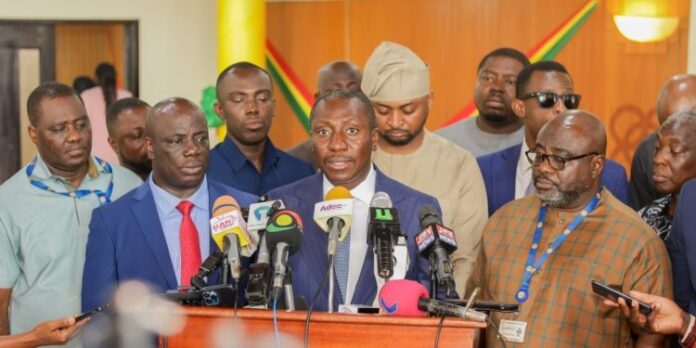

Minority Leader Alexander Afenyo-Markin has cautioned that Ghana risks losing key mining investments due to what he describes as an uncompetitive and frequently changing tax regime.
His remarks follow a meeting between the Minority Caucus and the Ghana Employers’ Association on March 31, where industry players outlined growing concerns about fiscal and regulatory pressures affecting multiple sectors.
Speaking after the engagement, the Effutu MP pointed to the heavy tax burden on mining companies as a major issue.
“The cumulative burden of royalties, corporate income tax, growth and sustainability levies, dividends and ancillary charges has produced an effective tax rate that is, by independent analysis, among the highest of any comparable mining jurisdiction in the world,” he said.
According to him, the effects are already evident in investor behaviour.
“The consequence is capital flight: Investment decisions that should be made in Ghana are being taken elsewhere, in jurisdictions with more stable and competitive fiscal regimes,” he added.
Mr Afenyo-Markin also raised concerns about proposals to shorten mining lease periods, warning that such a move could discourage long-term investment.
“The proposed reduction of mining lease tenure from thirty years to fifteen. Mining operations are capital-intensive, long-cycle investments. A 15-year lease does not provide the security necessary to justify the front-loaded expenditure such investments require,” he said.
He further identified policy inconsistency as a key challenge, noting that frequent changes to the fiscal framework create uncertainty for investors.
“The frequency with which Ghana’s mining fiscal regime has been revised, which has itself become a source of uncertainty sufficient to deter long-term commitment,” he noted.
The Minority Leader said calls from industry for a more predictable system are justified.
“The case made to us for a statutory stability framework, one that provides investors with binding fiscal certainty over the life of a project, is a case we found compelling,” he said.
Beyond the mining sector, he criticised what he described as inadequate stakeholder engagement in policymaking.
“Ghana’s employers are not asking for favours. They are asking for a state that engages before it acts, a regulatory environment that is stable and proportionate and a Parliament that takes the private sector seriously enough to defend it. Consultation that takes place after a decision has already been made is not consultation,” he stated.
He added that concerns raised by industry groups are often ignored.
“Industry bodies reported submitting formal written representations on pending legislation, receiving no substantive response and then watching their concerns be disregarded as if they had never been raised,” he said.
Touching on port operations, Mr Afenyo-Markin also flagged issues with the use of artificial intelligence in customs assessments.
“Specific cases were raised in which customs assessments generated by the AI system bore no rational relationship to actual transaction values,” he revealed.
While acknowledging the potential of technology, he warned about the absence of safeguards.
“An AI enforcement system operating against an unreformed duty schedule, without a functioning appeals process, does not produce fairer outcomes. It produces the same unjust outcomes, more efficiently and at a greater scale,” he said.
On the broader business climate, he argued that local enterprises are being disadvantaged.
“The picture described by Council members is of an operating environment that consistently advantages foreign capital over domestic enterprise,” he noted.
The Minority Caucus says it will take up the concerns in Parliament and advocate reforms to improve the investment climate.
“We will oppose any legislative change that reduces investment security in the sector without commensurate benefit to Ghana,” he stressed.
The delegation included Patricia Appiagyei, Jerry Ahmed Shaib, Kwaku Agyeman Kwarteng, Kojo Oppong Nkrumah, Michael Okyere Baafi, Fred Kyei Asamoah, Vincent Ekow Assafuah, Tweneboah Kodua Fokuo, John Darko, Frederick Addy, Gloria Owusu, and Damata Ama Appianimaa Salam.
ALSO READ: