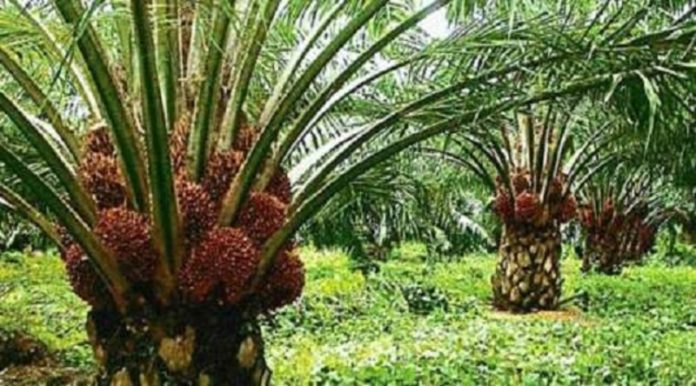

Minority Leader Alexander Afenyo-Markin has warned of what he describes as a deepening crisis in the oil palm sector, saying the industry is being left to operate far below its potential due to policy and financing failures.
The concerns were outlined after a Minority Caucus delegation met with the Ghana Employers’ Association on March 31 to discuss pressures facing businesses across key sectors of the economy.
The delegation included Patricia Appiagyei, Jerry Ahmed Shaib, Kwaku Agyeman Kwarteng, Kojo Oppong Nkrumah, Michael Okyere Baafi, Fred Kyei Asamoah, Vincent Ekow Assafuah, Tweneboah Kodua Fokuo, John Darko, Frederick Addy, Gloria Owusu and Damata Ama Appianimaa Salam.
According to Mr Afenyo-Markin, the oil palm industry has become a clear example of how structural gaps are holding back growth.
“The oil palm sector presented the Minority with a case study in the consequences of the absence of long-term agricultural financing,” he said.
He explained that oil palm production requires patient capital, which the current financial system cannot provide.
“Oil palm is a long-cycle tree crop. It demands patient capital of a kind that commercial banks are structurally unsuited to provide,” he noted.
He added that, unlike other producing countries, Ghana has failed to bridge that financing gap.
“In comparable producer economies, development finance institutions have filled this gap. In Ghana, that gap remains open, and the industry has not been able to scale as a result,” he said.
Beyond financing, land access remains a major obstacle for investors.
“Compounding this is a land tenure system that makes the acquisition of sufficient land for viable commercial cultivation legally uncertain and practically difficult,” he stated.
The Minority Leader warned that the combined effect of these challenges is suppressing output in a sector where Ghana has a natural advantage.
“The combined effect is an industry operating well below its productive potential, in a country that is a net importer of a commodity it has the conditions to produce at scale,” he said.
He also pointed to illegal trade as a major threat to local producers.
“The illicit trade dimension compounds the problem further. Smuggled crude palm oil entering Ghana at discounted prices displaces domestic production and destroys the commercial viability of investments that would otherwise create tens of thousands of jobs along the value chain,” he revealed.
According to him, this reflects a broader failure in enforcement and policy.
“This is a law enforcement and trade policy failure with direct economic consequences,” he added.
The Minority Leader stressed that the concerns raised by industry players are not new but reflect a pattern of neglect.
“The concerns raised are not new to this Caucus. Many of them we have already placed on the parliamentary record,” he said.
He said the engagement with the employers’ body has provided a clearer picture of the scale of the problem.
“What this engagement provides is a consolidated, evidence-grounded account of their scope and severity, from the organised employers who experience them directly,” he noted.
Afenyo-Markin insisted that the Minority will push for policy action to address the sector’s challenges.
“We will pursue the oil palm development financing proposal and the issue of illicit trade in agricultural commodities with the Ministry of Finance and the Ministry of Food and Agriculture,” he said.
He concluded that businesses are not seeking special treatment but a fair and responsive policy environment.
“Ghana’s employers are not asking for favours. They are asking for a state that engages before it acts, a regulatory environment that is stable and proportionate and a Parliament that takes the private sector seriously enough to defend it,” he said.