
The December 2025 National Tracking Poll by Global InfoAnalytics has provided a comprehensive snapshot of Ghana’s political, economic, and social landscape as the year ends.
Surveying 13,495 voters across 16 regions and 83 constituencies, the report reveals a nation broadly optimistic but marked by deep partisan divides and a strong appetite for systemic reform.
A Nation on the Move: Confidence and Polarisation
The survey’s most notable finding is the high level of confidence in the country’s trajectory.
Currently, 66% of Ghanaian voters believe the nation is headed in the “right direction,” a figure that has remained stable since last quarter.
Optimism is geographically widespread, with majorities in every region affirming that the country is on the right path.
Confidence is highest in the Upper West (81%) and Savannah (79%) regions, while even the Ashanti Region, traditionally an opposition stronghold, sees 45% of voters agreeing with the national direction.
Yet, the national sentiment masks a sharp partisan divide. While 91% of National Democratic Congress (NDC) voters see the country moving forward, 61% of New Patriotic Party (NPP) supporters believe it is on the “wrong direction.”
Floating voters, who often hold the balance of power, lean toward optimism, with 68% saying the country is on the right track.
Mahama’s Momentum: Leadership Approval
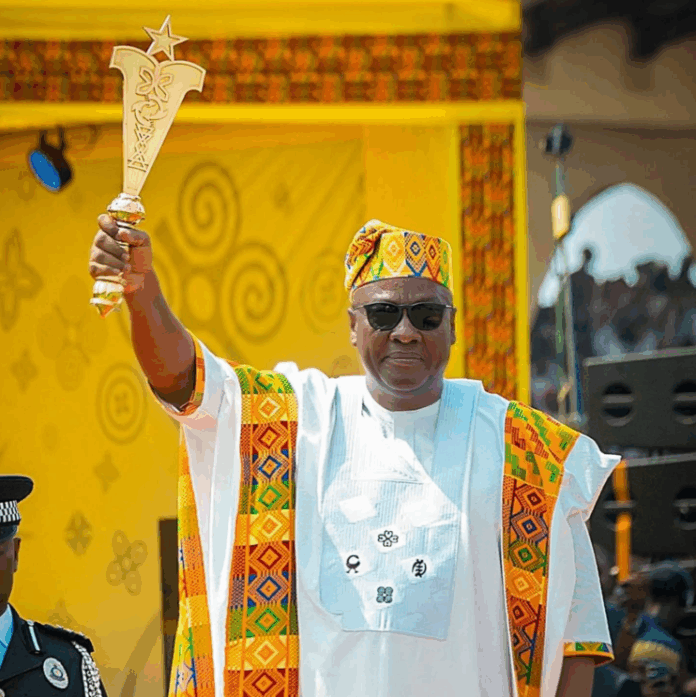
President John Mahama continues to enjoy strong public approval, with a job rating of 67%, unchanged from the previous quarter.
Support spans all regions, including areas typically aligned with the opposition. However, the partisan gap remains clear: 93% of NDC supporters approve of his performance, compared to just 28% of NPP voters.
Among floating voters, the President’s approval stands at 69%. While disapproval has inched up slightly to 24%, Mahama’s overall standing remains a key pillar of the administration’s strength.
The Economic Engine: Budget and Living Standards
Economic performance appears central to public satisfaction. The 2026 budget, presented by Finance Minister Dr. Cassiel Ato Baah Forson, has received strong backing, with 66% of voters satisfied, 18% dissatisfied, and 16% neutral.
Perceptions of living standards mirror this fiscal approval. Over half of the electorate (56%) say their standard of living has improved over the past year.
While 27% reported no change and 12% said it worsened, the general mood remains positive. Looking ahead, 70% believe their living standards will improve further in 2026, while only 18% are pessimistic.
Integrity and the Environment: Corruption and Galamsey
Governance indicators also show encouraging trends. Sixty percent of voters believe the government is doing enough to fight corruption, up from 58% last quarter, while 56% feel corruption is improving, and 17% believe it has worsened.
On illegal mining, or “galamsey,” 47% of voters nationally say the problem has not worsened under the current administration, including 43% in mining regions. Nationally, 56% of respondents feel the government is doing enough to tackle the menace.
The Mandate for Reform: Constitutional Change
Ghanaians are signaling readiness for major systemic reforms. The poll finds strong support for key recommendations from the Constitutional Review Commission:
Term Limits: 57% approve extending the presidential term to five years.
Separation of Powers: 58% approve barring MPs from holding ministerial posts.
Decentralisation: 63% support direct election of MMDCEs.
Youth Participation: 55% favour lowering the minimum age to run for president.
Modernisation: 58% support abolishing the death penalty, and 56% back restricting political campaigns to 120 days before elections.
The Changing Electorate: The Youth Surge
A demographic shift is reshaping Ghana’s political landscape. Gen Z and Millennial voters, under 44 years old, now account for nearly 78% of the electorate.
This generation is driving a preference for fresh leadership, with 64% supporting younger leaders.
The youth surge coincides with shifts in party affiliation. The NPP has seen a decline over three consecutive polls, now at 26%, while the NDC dipped slightly to 41%, and floating voters rose to 19%.
Notably, the NDC leads among tertiary-educated voters by 22 points and also holds a strong advantage among those with Junior High or Senior High education. The NPP performs best among voters with no formal qualification, narrowing the gap to a single point.
Conclusion
The December 2025 Global InfoAnalytics report paints a picture of a nation at a crossroads. While current leadership enjoys strong approval and confidence in economic and integrity-based policies, the deep partisan divide and overwhelming support for constitutional reform indicate that citizens are looking beyond the status quo.
With a dominant youth electorate now shaping political outcomes, Ghana’s future governance is likely to be defined by demands for accountability, younger leadership, and systemic structural change.