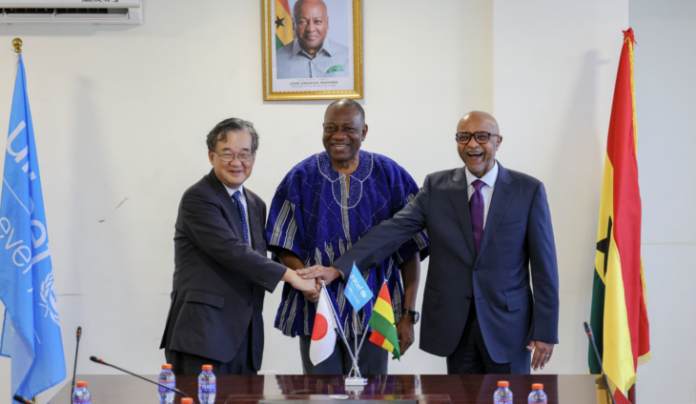

Ghana, Japan and UNICEF on Thursday launched a US$2.3 million public-private partnership to combat child labour in key sectors of the economy.
The 12-month initiative, led by UNICEF Ghana, in collaboration with the Ministry of Labour, Jobs and Employment, and the government of Japan, targets child labour in agriculture, mining and fisheries.
The project will be implemented in the Ashanti, Eastern, Western North, Ahafo and Central regions, targeting communities with high prevalence of child labour.
The programme is designed to address systemic drivers of child labour by strengthening social protection systems, expanding monitoring mechanisms and integrating digital solutions.
It will upgrade the Ghana Child Labour Monitoring System to improve the identification, reporting and management of cases, while also promoting environmentally sustainable practices in communities affected by climate change and illegal mining.
The initiative is expected to directly support more than 13,000 children and caregivers, while scaling up Child Labour Free Zones, a community-based approach ensuring children are withdrawn from work and enrolled in school.
The intervention comes at a time when about 1.1 million children are engaged in child labour in Ghana, with funding and capacity constraints identified as major challenges in addressing the issue.
Mr Osama Makkawi Khogali, the UNICEF Representative in Ghana, said the initiative adopted a comprehensive approach to child protection.
“Everything is connected: a child’s protection, their education, and their family’s economic resilience,” he said.
He noted that the project would use digital technology to make vulnerable children visible to social services and strengthen systems that support families.
Mr Hiroshi Yoshimoto, Japan’s Ambassador to Ghana, said the partnership reflected Japan’s commitment to promoting economic growth alongside human rights.
He said the initiative would bring Japanese innovation and private-sector expertise to support Ghana’s efforts to eliminate child labour, while strengthening responsible business practices in key sectors.
Dr Abdul-Rashid Hassan Pelpuo, Minister of Labour, Jobs and Employment, described child labour as a development challenge that undermined future national growth.
He said the Government would coordinate implementation of the programme to ensure its full execution, noting that the expansion of Child Labour Free Zones would be central to tackling the problem through an area-based approach.
The Project is expected to reach 13,100 direct beneficiaries, including 9,000 children and 4,100 caregivers, while providing case management and psychosocial support services to 6,000 vulnerable children.
About 100 stakeholders would also be trained in ethical business practices and child safeguarding.
The programme would integrate four major public and private data systems to enable real-time monitoring of child labour cases, while promoting the inclusion of women in district-level planning and protecting adolescent girls from exploitation.
It is also expected to reduce tensions in communities over land and water resources by improving access to social services, as Ghana faces an estimated 85 per cent funding gap in efforts to eliminate child labour.