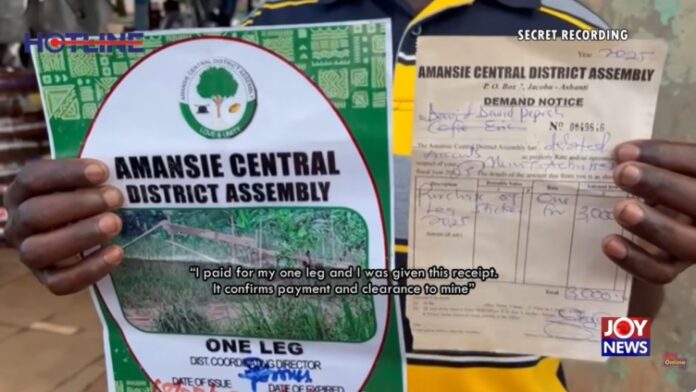

The Amansie Central District Assembly has rejected claims that it created a system to profit from illegal mining, insisting that revenue collection from operators of earth-moving equipment is a longstanding administrative practice spanning multiple governments.
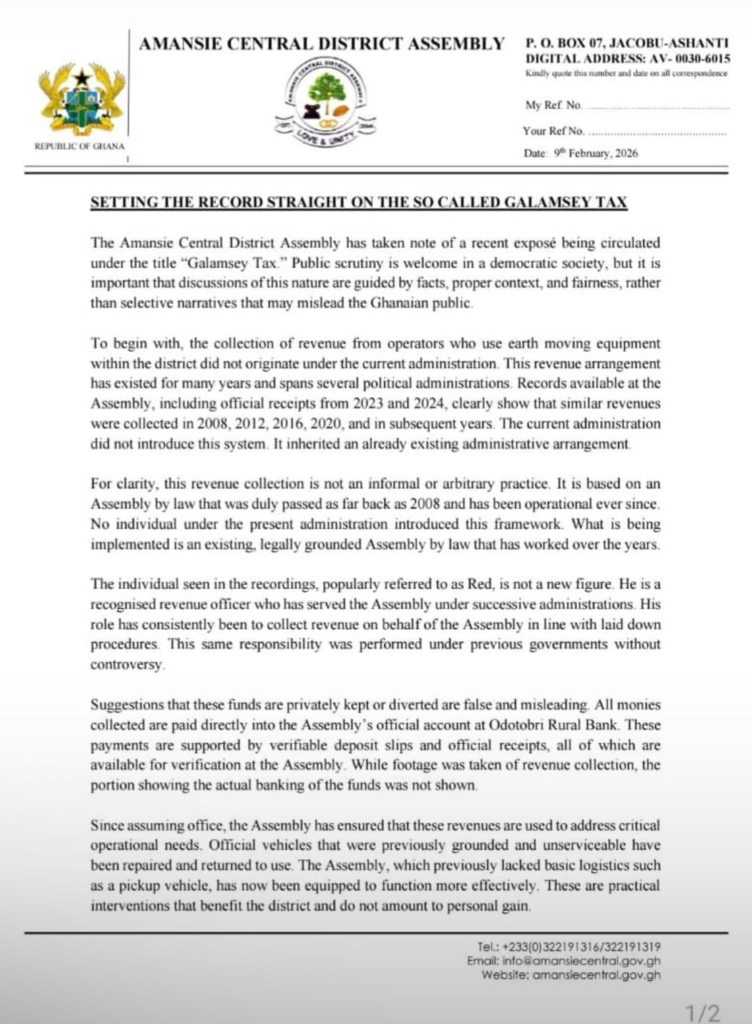
In a statement released on February 9, 2026, the Assembly’s Public Relations Officer said recent media reports linking the district to a so-called “galamsey tax” misrepresent established procedures to fit a “convenient political narrative.”
The clarification follows a JoyNews Hotline documentary that alleged a “pay-to-destroy syndicate” in the district, claiming miners pay GH₵6,000 annually to operate banned changfang machines with the tacit approval of local authorities.
The Assembly emphasised that revenue collection predates the current administration.
“Records available at the Assembly, including official receipts from 2023 and 2024, clearly show that similar revenues were collected in 2008, 2012, 2016, 2020, and subsequent years. The current administration did not introduce this system. It inherited an already existing administrative arrangement,” the statement read.
According to the Assembly, the practice is grounded in a 2008 bylaw that grants Metropolitan, Municipal, and District Assemblies the authority to regulate and collect revenue from operations within their jurisdictions.
The statement also addressed the individual featured prominently in the documentary, referred to as “Red,” clarifying that he is a recognised revenue officer who has served under successive administrations.
“His role has consistently been to collect revenue on behalf of the Assembly in line with laid-down procedures. This same responsibility was performed under previous governments without controversy.
“All funds collected, the Assembly stated, are deposited directly into its official account at Odotobri Rural Bank, supported by verifiable receipts and deposit slips. While the documentary showed portions of revenue collection, the Assembly noted, “the portion showing the actual banking of the funds was not shown,” the statement explained.
The Assembly said, revenues have been used to cover essential operational needs, including repairing official vehicles and providing basic logistics such as a pickup truck, measures intended to benefit the district rather than individuals.
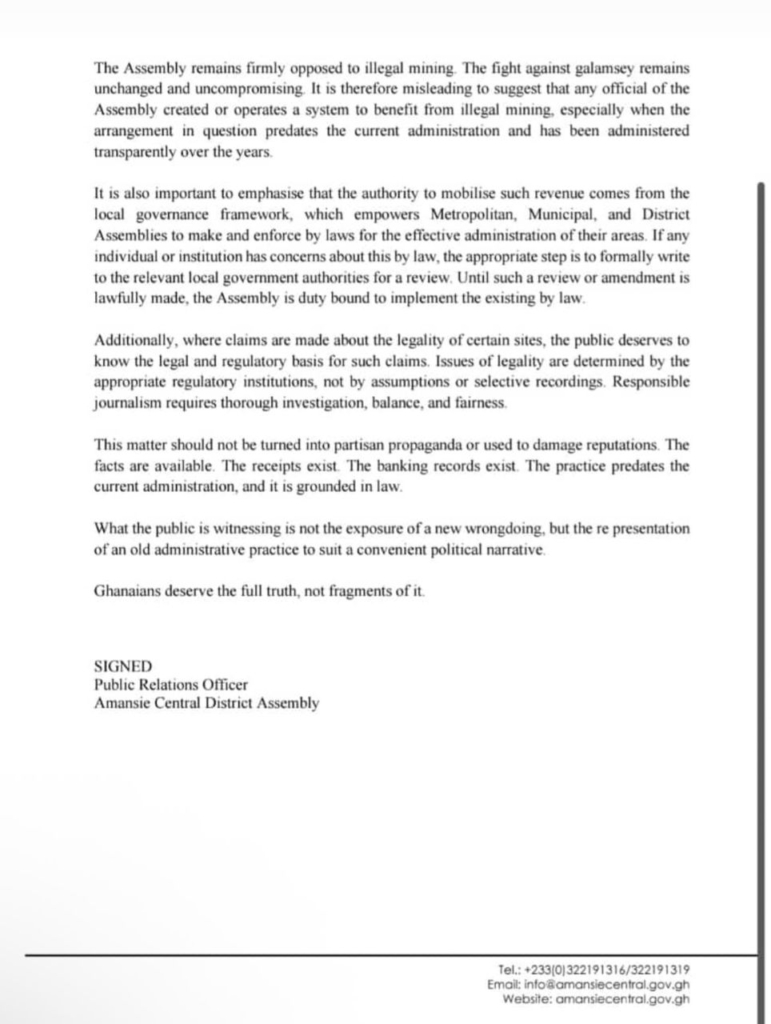
The Assembly reaffirmed its commitment to combating illegal mining, describing its efforts as “unchanged and uncompromising.”
It also argued that questions about the legality of mining sites fall under the jurisdiction of regulatory institutions, not selective recordings or media assumptions.
“Responsible journalism requires thorough investigation, balance, and fairness,” the statement said, cautioning against turning the matter into “partisan propaganda or using it to damage reputations.”
“What the public is witnessing is not the exposure of a new wrongdoing, but the re-presentation of an old administrative practice to suit a convenient political narrative. Ghanaians deserve the full truth, not fragments of it,” the statement asserted.
ALSO READ: