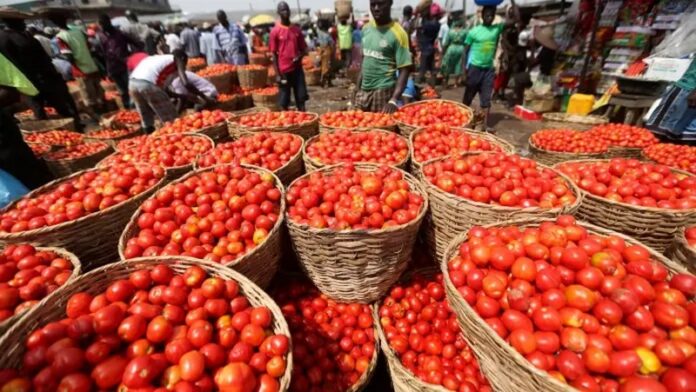

Tomato traders in Ghana say poor quality and high post-harvest losses are forcing them to rely on imports from Burkina Faso, even as a fresh export ban from the Sahelian country disrupts supply.
Speaking on Joy News’ PM Express, President of the Tomato Importers Association, Eric Tuffour, said locally produced tomatoes often fail to meet traders’ demands due to their short shelf life.
“The Ghanaian tomato was too watery, and when you travel with it, it doesn’t take long for it to deteriorate,” he said.
His comments come as Burkina Faso suspends all fresh tomato exports to protect its domestic processing industry, a move expected to hit Ghanaian traders hard.
Mr Tuffour explained that transporting Ghanaian tomatoes over long distances is risky and costly, especially when delays occur.
“Even if there is a breakdown of a vehicle for even just a day, by the time you get to the market centre, the tomato starts getting rotten,” he stated.
He contrasted this with tomatoes from Burkina Faso, which he said are more durable and commercially viable.
“The Burkinabe one was harder, and the life span of the tomato was good. You can keep it for a longer time,” he noted.
According to him, this difference in quality has shaped trader behaviour over the years.
“That is why we all tend to buy from there, because what the Ghanaian farmers were producing wasn’t favouring the traders, and the variety they produced wasn’t good for Ghanaian consumption,” he said.
The situation is further complicated by recent security risks along trade routes. Some Ghanaian traders were caught in crossfire involving terrorists in Titao, with reports indicating that some women lost their lives.
Despite these dangers, traders have continued to rely on Burkinabe tomatoes for their resilience and longer shelf life.
With the export ban now in place, concerns are growing over supply shortages and rising prices in local markets, as traders struggle to find reliable alternatives.