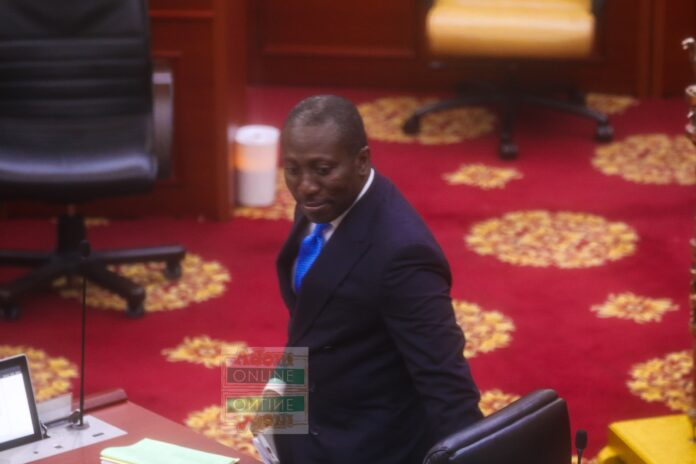

A heated exchange erupted in Parliament on Friday as the Majority and Minority leaders debated the growing global push for reparatory justice linked to the Transatlantic Slave Trade.
The Minority Leader, Alexander Afenyo-Markin, questioned the dominant narrative around reparations, arguing that discussions on compensation must also reckon with the role played by some African actors during the period.
The Effutu MP cautioned against what he described as a selective retelling of history, noting that certain local groups were involved in capturing and selling fellow Africans.
In his view, this dimension cannot be ignored when assigning responsibility.
“When somebody berths a vessel at Cape Coast, and you decide to go to the North, Bono area, get to the Ashanti area, and to the Assin area, and you are chasing your strongest among your own people, then after 100 years, you say, ‘I should be compensated’,” Mr Afenyo-Markin stated.
While acknowledging the cruelty and injustice suffered by victims, he raised concerns about present-day calls for financial redress without addressing internal complicity.
“Who should compensate whom? We maltreated our own and told the whiteman that he should also maltreat our own. The story must be told and must be put in its proper context,” he added.
Despite his reservations, he condemned the abuses of the era, stressing that the treatment of enslaved Africans remains indefensible.
“It is also a fact that the inhumane treatment, the unfortunate humiliation, the marginalisation, injustice and abuse of our ancestors who became victims of this slave trade must be condemned.”
Responding, Majority Leader and Bawku Central MP, Mahama Ayariga, defended the call for reparations, linking it to longstanding global economic inequalities.
He argued that much of the wealth accumulated in Western economies can be traced to centuries of unpaid, forced labour by enslaved Africans.
“Many of those countries that have wealth can trace their wealth to slavery. Many of the capitalist countries that have become rich started from plantations that were worked on by slaves. It is the labour of these slaves that helped them to build capital,” Mr Ayariga said.
According to him, the demand for reparations is ultimately about equity and historical recognition.
“As a result, there is the need to share that wealth in recognition of those who have been the foundation of the creation of that wealth,” he concluded.
ALSO READ: