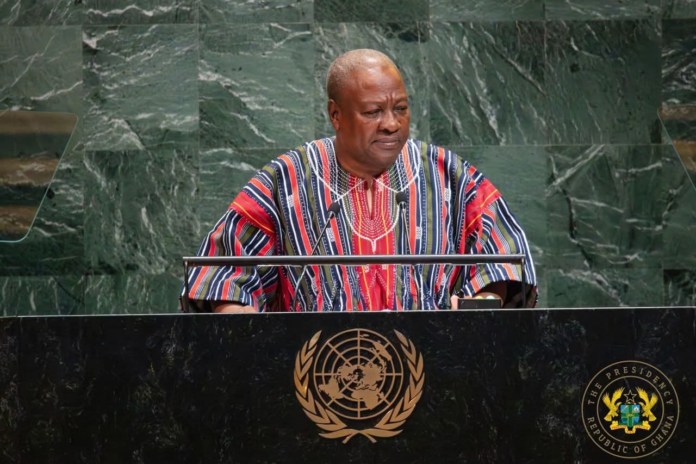

President John Dramani Mahama has called for a shift in how slavery is described globally, arguing that the language used should reflect the humanity of those affected.
Speaking at an event at the United Nations Headquarters, he stressed that people should not be defined as “slaves,” but rather as individuals who were forcibly trafficked and enslaved.
“Truth begins with language,” he stated. “There were human beings who were trafficked and then enslaved by people who believed they could own those human beings as chattels.”
His comments come as Ghana prepares to submit a resolution on March 25, 2026, seeking to have the Transatlantic Slave Trade formally recognised as the gravest crime against humanity, a move expected to revive global discussions on reparations and historical justice.
Mr. Mahama said reframing the narrative is not just about terminology but about restoring dignity and confronting the injustices that defined the era.
“The entire transatlantic slavery trade was designed to deny African people their humanity,” he said, noting that the system was built on a racial hierarchy that portrayed Black people as inferior.
According to him, the proposed resolution would help the international community acknowledge the scale of suffering endured during the period.
“This resolution allows us as a global community to collectively bear witness to the plight of more than 12.5 million men, women, and children whose lives were stolen,” he noted.
He added that the initiative represents a step toward healing and reparative justice for Ghana and the broader African diaspora, including communities across the Caribbean and Latin America.
Providing historical context, the President recounted the harsh realities of the slave trade—from capture and confinement in coastal dungeons to the Middle Passage, where many lost their lives. He also described how survivors were stripped of their identities and forced into labour under harsh conditions in the Americas.
“Violence begins with language,” he emphasised, cautioning against the continued use of terms that diminish the humanity of those affected.
The resolution, backed by the African Union and CARICOM, was first introduced during the 80th UN General Assembly and aims to support a global framework for restitution while addressing long-standing inequalities linked to slavery.
The initiative aligns with increasing international calls for reparatory justice, as countries and institutions continue to grapple with the enduring impact of the transatlantic slave trade.
ALSO READ: