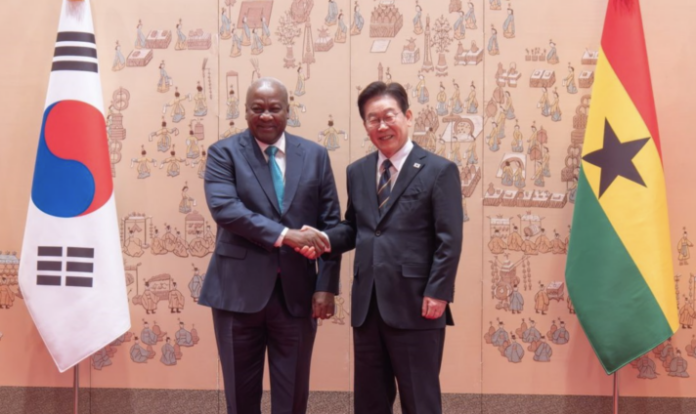

President John Dramani Mahama on Wednesday held bilateral talks with his South Korean counterpart President Lee Jae Myung in Seoul, South Korean.
The two leaders agreed to expand bilateral cooperation in trade, maritime security, climate change, and agriculture.
President Mahama arrived in South Korea on Tuesday, March 10, for a five-day working visit, becoming the first African leader to visit South Korea, since President Lee took office in June 2025.
President Mahama lauded the historic relations between Ghana and Korea, stating that they were proud of the shared values that binded the two countries, adding that, on bilateral relations, the countries focused strongly on agriculture and agribusiness to help achieve food security.
He noted that the two countries had deep respect for democracy, and a strong commitment to human rights, explianing that their relationship was not defined by the distance, but by the similarity of the values they shared.
He said the cooperation with the Korea International Cooperation Agency (KOICA) was important, particularly in increasing rice production through the K-Rice Belt Project.
“We look forward to the availability of high-yielding rice varieties that will help us expand production. Rice has now become a staple food in Ghana, and we want to reduce the amount of rice we import,” he added.
President Mahama said Africa had also established the African Continental Free Trade Area (AfCFTA), with the secretariat based in Accra, a historic agreement that opened up a market of about 1.4 billion people.
“Our goal is to position Ghana as a hub for production and exports to the rest of Africa, ” the President noted.
President Mahama said Ghana had abundant natural and human resources, while Korea had technology and innovation, and “I believe we can bring these strengths together in a win-win partnership. We are also committed to adding value to our products.”
“I would like to thank you for the chocolates you gave me. We enjoyed them yesterday, and I am pleased that I also brought you Ghanaian chocolates. So, we can both enjoy the sweetness of our chocolates.”
President Mahama said due to climate change, cocoa production had experienced some challenges; declaring that a few years ago, production declined, while this year they were experiencing overproduction, which had led to price fluctuations.
He explained that Ghana wanted to create more value by processing cocoa into products such as cocoa liquor and cocoa butter for export, allowing other industries to turn them into finished products.
He said, they were currently exploiting resources such as bauxite, manganese, and gold, and had discovered large reserves of lithium, nickel, and other rare minerals.
“Korea has the technology, and we believe we can explore these resources together — not exporting them in their raw form but adding value before exporting them to Korea and other markets.”
The President said Korea had long been a strong seafaring nation, and issues of maritime security were important to both countries.
“Piracy in the Gulf of Guinea is a major concern, and we are pleased that one of the memoranda we will sign today focuses on maritime safety and cooperation.”
He said Ghana had also emerged from a recent financial crisis; saying “We have successfully restructured our debt, and our economy is now back on track. Inflation is declining, our currency has strengthened, and we are meeting our debt obligations”
He said he look forward to accessing the Economic Development Cooperation Fund once again, was looking forward to signing a visa waiver agreement for diplomatic and official passport holders, which would make exchanges between their two countries much easier.
On his part, President Lee said there were growing trade and investment ties between the two countries and expressed the hope to further expand cooperation in various areas, describing Ghana as a major gateway to the African market.
“Ghana is a country we are grateful to, as it has actively cooperated in ensuring the safety of Korean nationals in the Gulf of Guinea, where piracy threats persist,” he added.
ALSO READ: