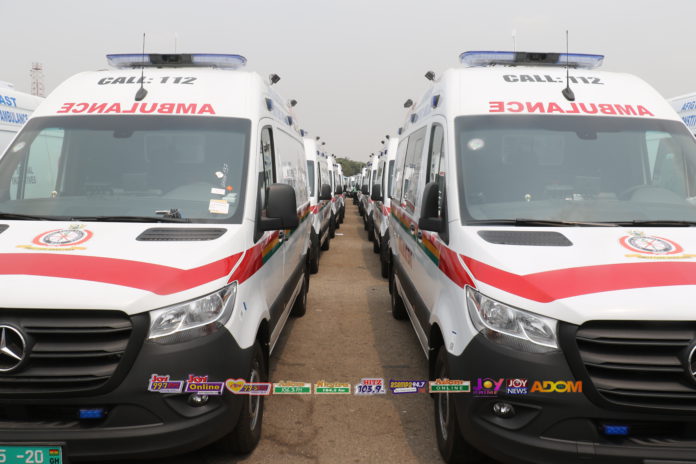

The National Ambulance Service (NAS) has denied allegations of negligence following the circulation of a viral video involving the transfer of a newborn baby.
The video, which generated public outrage, claimed that the NAS declined to transfer a neonate from the Kukuom District Hospital to the Goaso Government Hospital due to a lack of oxygen.
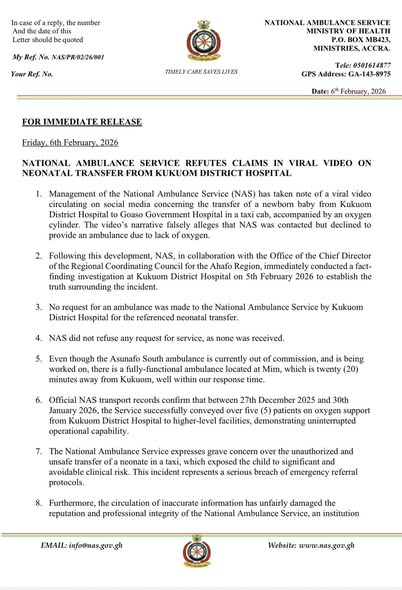
However, in a statement issued on Friday, February 6, 2026, the Service described the claims as false and misleading.
According to the NAS, a forensic review of its dispatch logs, together with an on-site investigation conducted at the Kukuom District Hospital on February 5, 2026, established that no request for an ambulance was ever made.
“No request for an ambulance was made to the National Ambulance Service by the Kukuom Government Hospital for the referenced neonatal transfer,” the statement said.
The Service explained that since no official request was received, the issue of oxygen availability did not arise. It stressed that it could not have refused assistance because the standard procedures required to activate an emergency neonatal transfer were never followed.
The NAS also expressed serious concern over reports that the newborn was eventually transported in a taxi, describing the action as unsafe and inappropriate for a critical medical referral. The Service warned that such unauthorised transfers expose patients to severe health risks by denying them access to life-saving equipment and trained paramedics.
The incident, the NAS noted, underscores broader challenges with inter-facility coordination within the region.
To prevent similar occurrences, the Service urged all health facilities to strictly comply with established emergency referral protocols.
These include placing a formal dispatch request to the NAS control room, coordinating with the receiving hospital ahead of transfer, and ensuring patients are transported under qualified medical supervision with appropriate neonatal support systems.
The National Ambulance Service reaffirmed its commitment to providing 24-hour emergency medical services nationwide and cautioned against the use of taxis for medical emergencies, stressing that patient safety must always remain the top priority.
ALSO READ:
I paid for every hour on oxygen, but she couldn’t survive…
Asunafo South: I’ve lost a treasure – Mother speaks after newborn…