
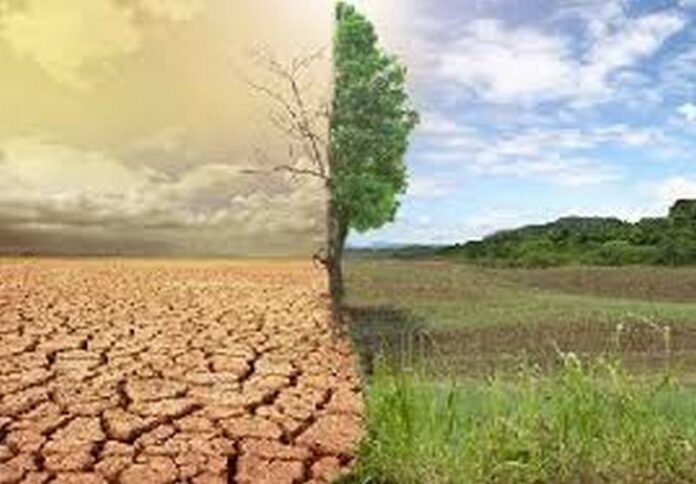

On a typical rainy morning in Accra, a police officer stands ankle-deep in floodwater, whistle in hand, directing traffic that is not moving anyway. The road has disappeared. The drains have failed. Tempers are rising.
Elsewhere, a patrol vehicle is stuck on a washed-out stretch of road, while an emergency call goes unanswered — not because officers do not care, but because nature has outpaced logistics. This is climate change in uniform.
For years, climate change in Ghana has been framed as an environmental or economic issue — about cocoa yields, coastal erosion, or energy transitions. But a quieter truth is emerging: climate change is also a law enforcement and public safety crisis, and the Ghana Police Service is already on the front line.
Climate change is changing how the police work. It does not announce itself with policy memos. It arrives as floods, heatwaves, storms, and displacement — and the police are often the first state institution citizens encounter when things fall apart.
Urban flooding, particularly in Accra, Kumasi, and coastal towns, has become more frequent and severe. Roads become impassable, police stations are threatened, and response times stretch dangerously thin. Officers who should be preventing crime are redeployed to crowd control, evacuation support, and traffic management in flood zones.
According to the World Bank’s Climate Risk Profile for Ghana, the country is experiencing increased intensity and frequency of extreme rainfall events, with urban areas especially vulnerable due to poor drainage and rapid, unplanned development. Every flood is not just an environmental failure; it is a security stress test.
Ghana is also getting hotter. Average temperatures are rising, and heatwaves are becoming more common. For police officers — many of whom work long hours outdoors in heavy uniforms or riot gear — this is not a minor inconvenience. Heat stress affects alertness, decision-making, physical endurance, and long-term health.
The Intergovernmental Panel on Climate Change (IPCC) has warned that rising temperatures will increasingly affect labour productivity and human health, particularly in tropical regions. In practical terms, a hotter Ghana means a more fatigued and overstretched police force operating under tougher conditions.
From climate shocks to social tension
Climate change does not stop at the weather. It spills into society. Floods destroy livelihoods. Heat reduces productivity. Failed rains affect food prices.
When economic pressure builds, social tension often follows — petty crime, protests, migration, and conflict over scarce resources. This link between climate stress and insecurity is now well established globally. The United Nations Office on Drugs and Crime (UNODC) has highlighted how environmental degradation and climate shocks can exacerbate crime and weaken governance structures.
In Ghana, the police increasingly find themselves managing climate-driven instability, even if it is not labelled as such.
The irony is stark. The institution expected to maintain order during climate disasters is itself exposed. Many police stations, barracks, and posts are located in flood-prone areas. Drainage systems are inadequate. Storms damage equipment and records. Vehicles suffer wear and tear from extreme weather. Yet climate resilience is rarely part of police infrastructure planning.
The question is unavoidable: who is protecting the protectors?
The Ghana Police Service is not only affected by climate change; it can also be a powerful force in combating it — if properly empowered and integrated into national climate strategy.
Environmental crime is climate crime. Illegal mining (galamsey), illegal logging, sand winning, and pollution of water bodies all accelerate climate vulnerability. While specialised agencies exist, enforcement often collapses without police support.
A visible, well-resourced police role in environmental law enforcement would deter environmental destruction, protect water bodies and forests, and reinforce the rule of law in climate governance. This aligns with broader governance goals highlighted by UNDP Ghana, which emphasises the role of institutions in climate adaptation.
Climate change should be built into police planning, not treated as an occasional emergency. This means training officers in disaster response and climate risk awareness, integrating climate forecasts into deployment and operations, and designing climate-resilient police stations and barracks.
The Ghana Meteorological Agency already provides climate and weather data that could inform policing decisions more strategically. This is not futuristic thinking — it is basic preparedness.
The police remain one of the most visible arms of the state, and that visibility matters. Through community policing structures, officers can reinforce environmental laws, support sanitation enforcement, and partner with local leaders on climate resilience efforts.
When climate rules are backed by trusted institutions, compliance improves. Climate action succeeds faster when it feels legitimate, not imposed.
Despite all this, climate change is still largely absent from police training curricula, national security conversations, and climate adaptation planning frameworks.
Ghana has climate policies. Ghana has security strategies. What is missing is the bridge between them. If climate change is a threat multiplier, as global evidence suggests, then excluding the police from climate planning is not just an oversight — it is a risk.
Protecting the climate is protecting public safety.
Climate change is no longer a future threat for Ghana. It is here — soaked into our roads, baked into our heat, and written into the daily work of the Ghana Police Service.
Every flood an officer responds to, every traffic jam caused by a storm, every protest triggered by economic stress — these are climate stories wearing the mask of routine policing.
If Ghana is serious about climate resilience, it must start seeing climate change not only as an environmental issue, but as a public safety imperative. Because when climate change knocks, it does not ask who is on duty — and more often than not, the police are already there.
The writer, Shadrach Assan, is the lead producer for Adom FM’s morning show, Dwaso Nsem.