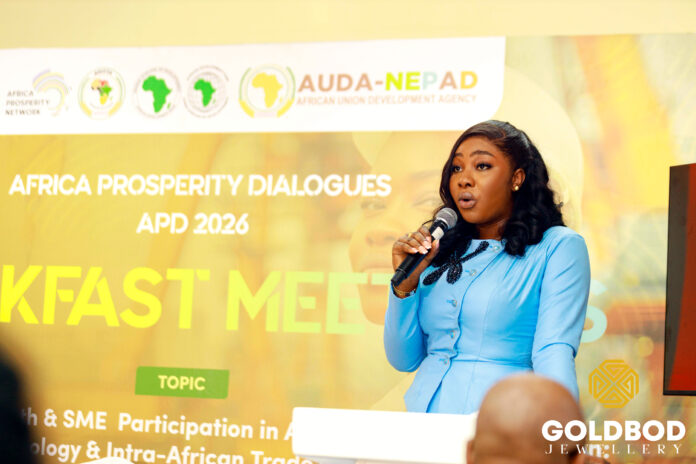

The Managing Director of Goldbod Jewellery, Gertrude Emefa Donkor Esq, has called for deliberate and systemic reforms to empower youth, women, and small and medium-sized enterprises in Ghana’s mining sector, describing their inclusion as essential to sustainable and inclusive national development.
Delivering the keynote address at the Africa Prosperity Dialogues 2026 breakfast meeting, Ms Donkor noted that youth, women, and SMEs represent the demographic majority and the backbone of rural mining economies, yet they are often sidelined by policies and strategies focused on large-scale, capital-intensive operations.
According to her, overlooking these groups deepens inequality, wastes human potential, fuels poverty in mining communities, and undermines Ghana’s broader goals of economic transformation, gender equity, and poverty reduction.
She highlighted the significant but underappreciated role of women and youth in artisanal and small-scale mining (ASM), which accounts for a substantial share of Ghana’s gold production and employs about one million people directly.
Women, she noted, make up an estimated 40 to 50 percent of the ASM workforce in many African contexts, including Ghana, while youth are increasingly drawn into the sector due to unemployment, climate-related challenges in agriculture, and limited alternatives.
Many SMEs operating in the sector, often youth- or women-led, remain informal and excluded from mainstream value chains.
Ms Donkor outlined key structural challenges limiting their impact, including skills gaps, limited access to finance, complex regulatory systems, and exclusion from procurement and trade opportunities.
She explained that the lack of formal training in safety, environmentally responsible mining, business management, and modern technologies leads to low productivity, unsafe practices, and environmental harm.
Financial barriers, such as high interest rates, collateral requirements, and gender biases in lending, further trap operators in cycles of debt and prevent growth.
She also pointed to regulatory bottlenecks that discourage formalization, contributing to illegal mining and revenue losses, while cultural stereotypes and unsafe working conditions continue to marginalize women, exposing them to health risks and gender-based violence.
To address these challenges, the Goldbod Jewellery Managing Director called for intentional national action, including the rollout of targeted technical and vocational training programs, apprenticeships, and certification pathways for youth and women in responsible mining and entrepreneurship.
She advocated for collateral-light and gold-backed financing options, regulatory simplification through digital one-stop platforms, and stronger enforcement of local content policies to integrate Ghanaian SMEs into mining supply chains and regional markets under AfCFTA.
Ms Donkor also stressed the need for cultural change through community engagement, mentorship, business incubation, and policies that promote safe, inclusive, and gender-sensitive work environments.
She urged mining companies to adopt progressive quotas to increase youth and women representation in operational, technical, and leadership roles, in line with international standards such as the Sustainable Development Goals and International Labour Organization conventions.
Speaking on the role of the Ghana Gold Board (GoldBod), established under the Gold Board Act, 2025 (Act 1140), she explained that the institution is supporting inclusive growth by providing fair, transparent, and immediate payment for gold from licensed ASM operators.
This, she said, reduces dependence on exploitative middlemen and improves cash flow for youth- and women-led enterprises.
GoldBod is also rolling out geological support services, access to appropriate machinery, digital traceability systems, and initiatives to promote local refining and value addition.
She added that GoldBod prioritizes the employment of women and youth within its own operations and supports community-based awareness and training programs to promote responsible and inclusive mining practices.
Ms Donkor further called on government, industry players, communities, and development partners to collaborate in transforming mining into a sector that promotes equity, dignity, and shared prosperity.
She emphasized that with intentional systems, supportive financing, safe environments, and aligned global standards, Ghana can unlock the full potential of youth, women, and SMEs in mining for national development.
ALSO READ: