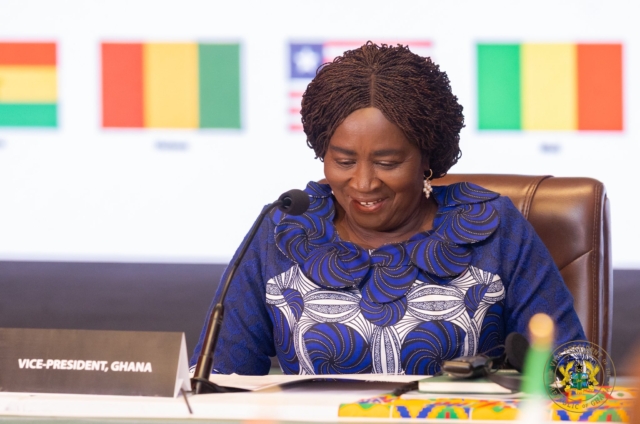

Vice President Prof. Jane Naana Opoku-Agyemang has said Ghana’s proposed 24-hour economy policy holds significant potential to boost productivity, expand trade and accelerate industrial growth across the country.
According to her, the initiative seeks to eliminate structural and operational delays that hinder business efficiency by strengthening coordination among infrastructure, financing and public institutions. She noted that many productive hours are currently lost due to avoidable systemic bottlenecks.
Prof. Opoku-Agyemang made the remarks while addressing participants at the Africa Prosperity Dialogues on Wednesday, February 4.
She explained that a round-the-clock economic framework would complement the government’s broader industrial strategy, including skills development, sector prioritisation and the promotion of sustainable production systems.
The Vice President also linked the policy to Ghana’s regional and continental ambitions, noting that it aligns with integration efforts under ECOWAS and the African Union, and would enhance Ghana’s role in African trade and economic cooperation.
“Our 24-hour economy initiative is designed to unlock productivity by better coordinating infrastructure, finance and institutions, ensuring that businesses and workers are no longer constrained by avoidable bottlenecks or lost time,” she stated.
Prof. Opoku-Agyemang added that when implemented alongside the government’s Big Push Infrastructure Development programme, the policy would provide a strong foundation for innovation, competitiveness and long-term industrial expansion.
She stressed that the ultimate goal is to position Ghana as a strategic hub in Africa’s evolving economic landscape, where efficiency, reliability and continuous production drive national development.
ALSO READ: