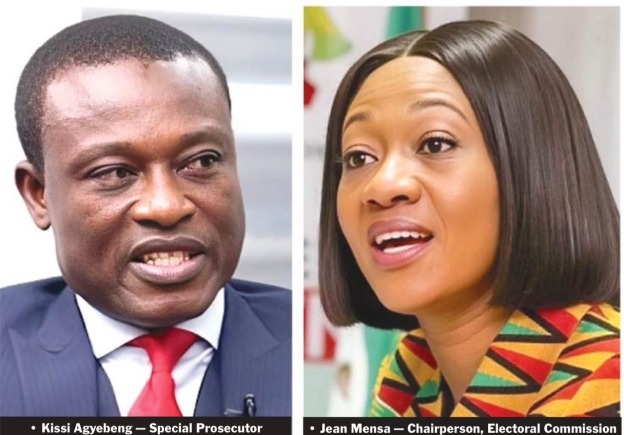

The Minister in Charge of Government Communications, Felix Kwakye Ofosu, has announced that ten petitions filed against Special Prosecutor Kissi Agyebeng and the Chairperson of the Electoral Commission (EC), Jean Mensa, along with her two deputies, have been formally transmitted to the Chief Justice, Justice Paul Baffoe-Bonnie, for consideration.
Speaking to journalists at the Government Accountability Series in Accra on Wednesday, Mr. Kwakye Ofosu explained that President John Mahama has fulfilled his constitutional duty by forwarding the petitions and will not play any further role unless required after the Chief Justice’s review.
“Unlike petitions against the Chief Justice, the President’s mandate regarding petitions against the Special Prosecutor and the Electoral Commissioner and her two deputies ends with conveying them to the appropriate authority—in this case, the Chief Justice. That was done a couple of weeks ago,” he stated.
He further noted that the ten petitions are divided between the EC leadership and the Special Prosecutor: seven target the Electoral Commissioner and her deputies, while three are directed at the Special Prosecutor.
“The President has no role beyond that. The Chief Justice’s office may be in a better position to comment. The President will be called upon to act only after the Chief Justice has determined whether a prima facie case exists,” he added.
The petitions, submitted by individuals and civil society groups, accuse the EC Chair and her deputies of accountability and administrative lapses, while the complaints against the Special Prosecutor cite alleged incompetence and abuse of office.
Under Section 16 of the Office of the Special Prosecutor Act, 2017 (Act 959), petitions seeking the removal of a Special Prosecutor must be sent by the President to the Chief Justice within seven days.
The Chief Justice then has 30 days to determine whether a prima facie case exists. If established, a three-member committee is empanelled to investigate and submit recommendations to the President.
The Chief Justice’s decision will determine whether the petitions warrant further inquiry before any subsequent constitutional steps are taken.
ALSO READ: