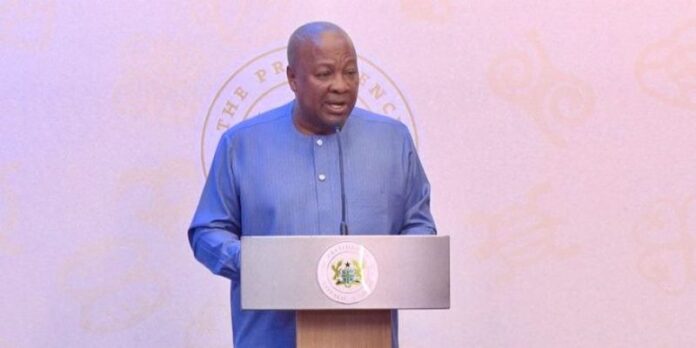

The year 2025 will be remembered as a defining period for Ghana’s education sector—a year marked by difficult choices, honest national reflection, and the beginning of a deliberate reset under President John Dramani Mahama.
When President Mahama and his Minister for Education, Haruna Iddrisu, assumed office, they inherited an education system burdened by deep structural challenges.
Years of accumulated debt, weak investment in basic education, unpaid statutory obligations, stalled infrastructure projects, and unresolved teacher welfare issues had significantly constrained service delivery and threatened the quality and sustainability of education at all levels.
From the Free Senior High School (Free SHS) programme and special needs education to expired teacher recruitment windows, struggling nascent public universities, unpaid obligations to the West African Examinations Council (WAEC), and delays in promotions and allowances for teachers, the scale of inherited difficulties was enormous.
A National Conversation to Reset Education
Recognising the urgency and complexity of the situation, President Mahama and the Education Ministry convened a historic National Education Forum in Ho, in the Volta Region.
The forum brought together key stakeholders—teachers, unions, parents, academics, students, civil society organisations, policymakers, and the President himself—for a frank and solutions-oriented dialogue on the future of Ghana’s education system.
The outcome of the Ho Forum was a set of practical recommendations that now form the backbone of ongoing reforms, implemented alongside the President’s manifesto commitments and the National Democratic Congress (NDC) government’s broader human capital development agenda.
Education as a Budgetary Priority
A clear test of any government’s commitment to transformation lies in how it allocates resources. From the outset, President Mahama demonstrated this commitment by prioritising education in his maiden budget.
In the 2025 Budget Statement, education received one of the largest sectoral allocations, aimed at stabilising the system and laying the foundation for long-term reform.
Historic Investment in Basic Education
For the first time in over five decades, basic education received a historic allocation of GHC 9.1 billion—the highest in 50 years.
This decisive investment reflects a renewed focus on foundational learning, which had suffered years of neglect despite being the most critical stage in a child’s educational journey.
The funding is already supporting classroom infrastructure, learning materials, sanitation, and teacher support at the basic level nationwide.
Resetting Free SHS: From Access to Quality
While the Free SHS policy succeeded in expanding access, it was inherited in a form that prioritised enrolment over quality, resulting in overcrowding, infrastructure deficits, and the controversial double-track system that reduced teacher–student contact hours.
President Mahama’s administration has embarked on a reset—maintaining Free SHS while transforming it into a sustainable and high-quality programme for national development.
In 2025, Free SHS received GHC 3.5 billion under GETFund, the highest allocation since the programme began. This funding has strengthened student feeding, logistics, and learning conditions.
Notably, about 100 double-track schools have already been converted to single-track, with a firm commitment to abolish the system entirely.
Additionally, government plans include upgrading:
10 Category D schools to Category C
10 Category C schools to Category B
30 Category B schools to Category A
while improving infrastructure in existing Category A schools.
Improved Feeding and Student Welfare
Reforms in the management of SHS feeding have led to noticeable improvements, with positive feedback from students, teachers, parents, and school administrators.
Government continues to engage stakeholders to further enhance both nutrition and learning outcomes. At the basic level, GHC 895 million has been paid to support the School Feeding Programme, alongside an increase in the feeding grant per child.
Advancing Girls’ Education
In a major step toward gender equity, government rolled out the free distribution of sanitary pads to school-going girls.
Over six million sanitary pads have been distributed to girls in basic and second-cycle schools, reducing absenteeism and helping to keep girls in school.
Clearing Arrears and Supporting Schools
Under the year in review, the Ministry of Education cleared inherited arrears, including:
GHC 72.8 million in Capitation Grant arrears
GHC 122.8 million paid timely for BECE registration
Payment of WASSCE practical fees
Feeding grants for special needs schools
Government has also directed all Metropolitan, Municipal and District Assemblies to construct a Nursery, Primary and JHS from the 2025 District Assemblies Common Fund (DACF).
Teachers at the Centre of Reform
Teacher welfare featured prominently in 2025. Key achievements include:
Payment of GHC 52 million in Teacher Training Allowance
Restoration of promotion eligibility up to Director rank
Cancellation of the Teacher Licensure Exams requirement that forced trainees to return to campus months after graduation
Placement of over 30,000 diploma teachers who upgraded to degrees onto the appropriate PS salary scale. PTAs have also been reactivated nationwide to strengthen school governance and discipline.
Revitalising Infrastructure and Tertiary Education
All stalled E-Blocks (Community Day SHSs) are being revisited, while tertiary education saw landmark interventions.
Under the No Fees Stress Initiative, the Students Loan Trust Fund reimbursed academic facility user fees for first-year students in public tertiary institutions. Out of 178,745 enrolment records, 152,698 students were successfully validated and reimbursed—removing financial barriers to access tertiary education.
President Mahama also approved the construction of a 600-bed hostel at Dr. Hilla Limann Technical University, addressing a long-standing accommodation challenge.
To strengthen nascent public universities, government released GHC 40 million in seed funding, with GHC 10 million each allocated to:
C.K. Tedam University of Technology and Applied Sciences
University of Energy and Natural Resources
University of Health and Allied Sciences
S.D. Dombo University of Business and Integrated Development Studies
Reforming Scholarships
Parliament has passed the Scholarship Authority Bill, now awaiting Presidential assent. The Bill aims to eliminate cronyism and political interference in scholarship awards, promote transparency and fairness, and align scholarships with national skills needs through collaboration with the National Development Planning Commission.
Looking Ahead to 2026
The 2026 Budget has allocated GHC 33.3 billion to education, with priorities including:
Upgrading 30 Category C SHSs to Category B
Completing 30 abandoned E-Blocks
Constructing 200 JHSs, 200 primary schools, and 200 kindergartens
Building 400 teachers’ bungalows
Procuring and distributing millions of curriculum-based textbooks .
Supplying desks, buses, pickups, and administrative vehicles to schools and education directorates
Conclusion
The 2025 year under review confirms that Ghana’s education sector is on a deliberate path of recovery and transformation.
Through honest diagnosis, historic investment, and people-centred reforms, President John Dramani Mahama and the Ministry of Education have begun rebuilding confidence in the system—laying a strong foundation for quality, equity, and sustainable human capital development in the years ahead.