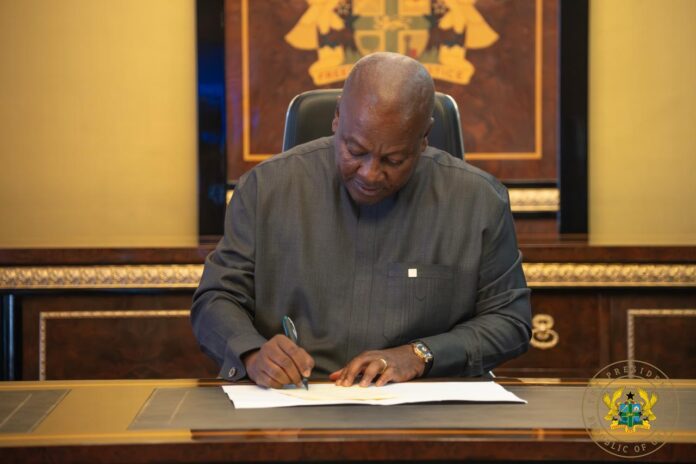

President John Dramani Mahama has assented to the Virtual Asset Service Providers (VASP) Bill, formally ushering Ghana’s cryptocurrency and digital assets space into a regulated legal framework.
The signing follows the passage of the bill by Parliament after months of debate and stakeholder engagement, marking a significant step toward improving investor protection and safeguarding market integrity within the country’s fast-growing digital finance ecosystem.
The development was confirmed by the Deputy Director-General of the Securities and Exchange Commission (SEC), Mensah Thompson, in a statement shared on his official Facebook page. He explained that the new law gives legal backing to activities within the virtual assets space.
“The Bill, among other things, legalizes the usage, trading and provision of services in the virtual assets (including cryptocurrencies) space,” Thompson stated.
He also commended President Mahama, the Minister of Finance, the Governor of the Bank of Ghana, and the leadership of the SEC for steering the legislation to completion.
Under the new law, regulatory oversight of virtual asset activities will be jointly handled by the SEC and the Bank of Ghana. All virtual asset service providers are expected to operate within clearly defined rules aimed at transparency, accountability, and consumer protection.
Thompson further noted that the law benefited from bipartisan support in Parliament and input from industry players, exchanges, and technical teams from both the SEC and the central bank. According to him, the collaborative process reflects Ghana’s commitment to aligning its financial system with evolving global standards.
With the VASP Act now in force, digital asset activities that previously operated without formal regulation, such as trading, investment services, and asset issuance, will now be subject to legal supervision.
Financial analysts believe this will boost investor confidence and position Ghana as a competitive player in the global digital economy.
The move also fits into the government’s broader agenda to modernize the financial sector, encourage innovation, and ensure a secure environment for digital financial services, at a time when countries worldwide are tightening oversight of cryptocurrencies and related technologies.
ALSO READ: